Turn files into AR/VR 🥽 experiences

A Virtual Worlds Mixer (VWM), powered by JanusXR & XR Fragments.
A static website generator for interconnected XR experiences.


What is it

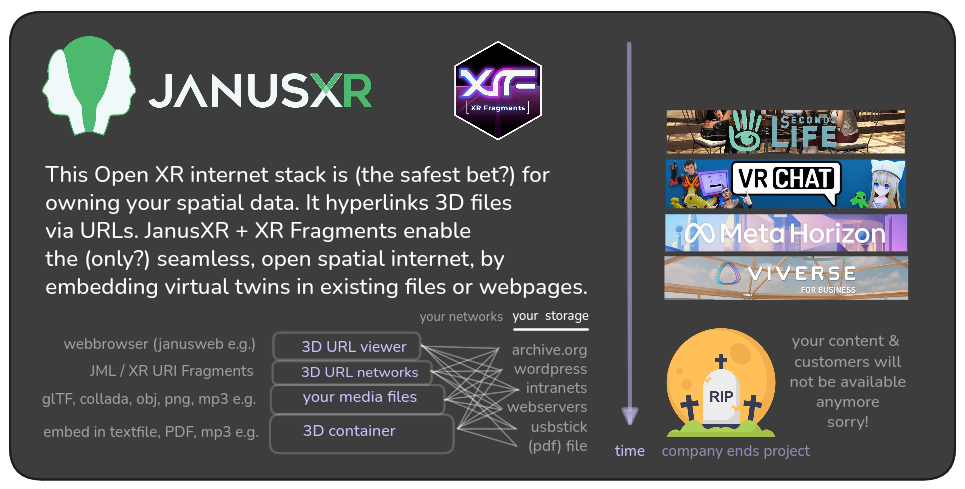
An open, seamless XR web built from simple URLs and directories, without gatekeepers.
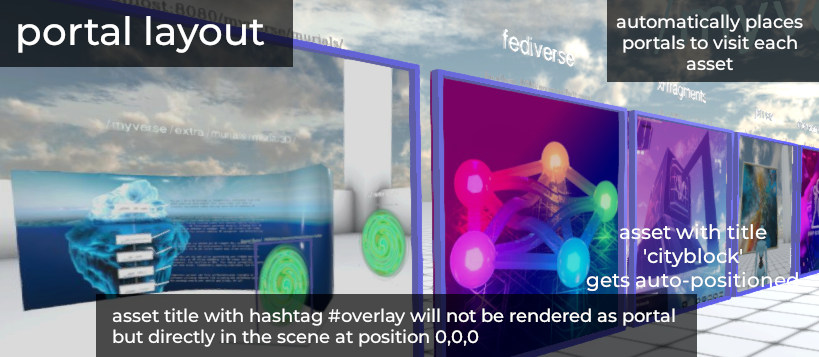
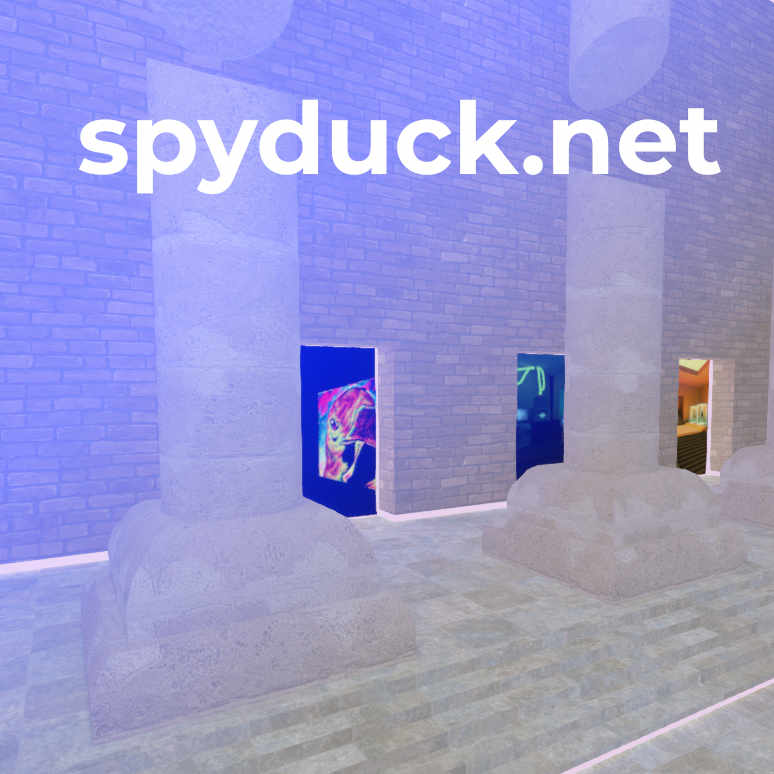
XRForge transforms standard local or remote file directories into interconnected 3D spaces. Users can seamlessly "surf" spatial webs (plural!), turning everyday directories and URLs into 3D portals.


Why people want XRForge

In short: scalable spatial blog/wiki's (using plain web URLs) interconnected via 3D portals; bringing existing 2D ecosystems into XR.
How? Well it's backed by JanusXR- and XR Fragment- URLs.
The metaverse hype has shown: people like 3D but certain existing 2D ecosystems are king.
XRForge makes things more cost-efficient by projecting existing 2D ecosystems as virtual hyperlinked worlds, via JanusXR translators, tapping into various datastores

Support for datastores:
Icosa.gallery
Manyfold
Azure Blob
Azure Files
B2
Box
Cloudinary
Doi
Drime
Drive
Dropbox
Fichier
Filefabric
Filelu
Filen
Filescom
FTP
Gofile
Google Cloud Storage
Google Photos
HDFS
Hidrive
HTTP
Iclouddrive
Imagekit
Internet Archive
Internxt
Jottacloud
Koofr
Linkbox
Local
Mailru
Mega
Memory
Netstorage
Onedrive
Opendrive
Oracle Object Storage
Pcloud
Pikpak
Pixeldrain
Premiumizeme
Proton Drive
Putio
Qingstor
Quatrix
S3
Seafile
SFTP
Shade
Sharefile
Sia
SMB
Storj
Sugarsync
Swift
Ulozto
WebDAV
Yandex
Zoho
, making it perfect for large organisations.
The Fediverse , a fleet of ad-free federated platforms, makes an excellent backoffice for virtual XR hypermedia experiences.
Federated experiences allow anybody to extend existing open-source foundations and shared data foundations to accelerate XR innovation , by allowing them to "remix" and expand the world .
Byebye constantly reinventing the wheel / walled gardens.
Hello post-scarcity technology.

Auto-compose virtual worlds

Instead of manually composing virtual worlds from multiple assets, XRForge's allows mixing 3D content via auto-layout, symbolic/online links, and interoperability.
This means that existing RSS/Atom-feeds (from blogs), partial content from websites, and 3D scenes can be projected as virtual worlds.
But also assets produced elsewhere, 3D scenes in OpenBlocks or OpenBrush are synchronized (via online 3D stores like icosa.gallery- and manyfold.app).
This allows for infinitely scalable virtual worlds, yet completely downloadable and portable.
XRForge features layout-engines which allows crowdsourcing virtual worlds via assets using various apps/platforms:


An example:
1. designers agree on a hashtag (#myproject e.g)
2. add the hashtag to the asset-title (in openbrush/openblocks/manyfold e.g.)
3. add the hashtag to XRForge (in the respective plugin)
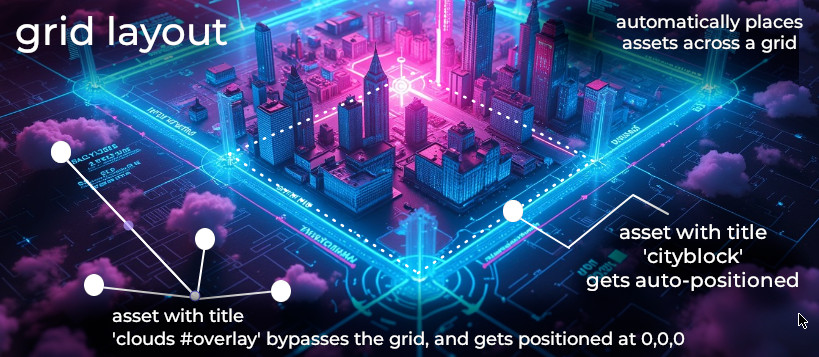
4. specify the layout (grid, portals e.g.) for rendering the assets
4. XRForge will pull or reference all hashtag-related assets
5. Profit! XRForge will now automatically render a virtual world

By default all scenes are layered on top of eachother, which is great for horizon, sky etc.
However, auto-placement in a grid (buildings e.g.) is possible by adding a dimensional hashtag (#2x2 e.g.) to the asset-title.

Comparison

XRForge Other solutions
(Meta Horizon e.g.)
No data-collection or login requirement ✅ ❌
users can host content themselves ✅ HTTP/DAT/IPFS Open Protocols ❌ they own your data
User operated content and viewers ✅ ❌ they control both
portals to remote content ✅ JanusXR or XR Fragments protocol ❌
Platform does not control network ✅ user-operated viewers and content ❌ stakeholders can block anything
Platform to Platform portals ✅ JanusXR or XR Fragments protocol ❌
2D web to 3D translators ✅ JanusWeb translators ❌
Embed 3D scene in regular file (pdf e.g.) ✅ supported via JanusWeb ❌
Portals from/to Internet/Intranet ✅ ❌
User can make content private ✅ XRForge permissions or HTTP password ❌
Spatial anchors / URL addressibility ✅ JanusWeb and XR Fragments protocol ❌
Direct portals to 3D file ✅ Janusweb and XR Fragments protocol ❌
Detect 3D scene in webpage URL ✅ Janusweb and XR Fragments protocol ❌
Export data + Credible exit ✅ server-export runs on opensource janusweb viewer ❌
Lightweight (runs on Raspberry PI e.g.) ✅ ❌
XR worlds at rest ✅ ❌ compute required for nonvisited spaces
Integrates with Fediverse ✅ via ActivityPub and RSS/HTML translators ❌
Integrate with (own) dataclouds ✅ scroll down below
Via rclone: Google Drive, Amazon S3, Microsoft OneDrive, Dropbox, Backblaze B2, SFTP, Google Cloud Storage (GCS), Microsoft Azure Blob Storage, MinIO, FTP, WebDAV, Wasabi, Cloudflare R2, Local Filesystem, MEGA, pCloud, Nextcloud, DigitalOcean Spaces, Hetzner Storage Box, Box, Google Photos, iCloud Drive, SMB/CIFS, Oracle Object Storage, Proton Drive, IDrive e2, Alibaba Cloud (Aliyun) OSS, Yandex Disk, Hetzner Object Storage, OVHcloud, ownCloud, Scaleway, Koofr, Put.io, Seafile, Mail.ru, 1Fichier, Akamai NetStorage, Internet Archive, Jottacloud, Storj, Tencent COS, Huawei OBS, Qiniu Kodo, OpenStack Swift, Arvan Cloud AOS, Bizfly Cloud, Ceph, China Mobile Ecloud, Citrix ShareFile, Cloudinary, Cubbit, Digi Storage, Dreamhost, Drime, Enterprise File Fabric, Exaba, Fastmail Files, FileLu Cloud, Filen, Files.com, Gofile, HDFS, HiDrive, HTTP, ImageKit, Internxt, IONOS Cloud, Leviia, Liara, Linkbox, Magalu, Memory, OpenDrive, Oracle Cloud Storage, Outscale, Petabox, PikPak, Pixeldrain, Premiumize.me, QingStor, Quatrix, Rabata, RackCorp, Rackspace Cloud Files, Rsync.net, Scaleway, Seafile, Seagate Lyve Cloud, SeaweedFS, Selectel, Servercore, Spectra Logic, Storj, SugarSync, Uloz.to, Zoho WorkDrive
❌


JanusXR: The deep spatial web (within the web)